Featured
Table of Contents
Lots of individuals utilize voice look for purchase-related inquiries, such as making online purchases and developing shopping lists. Voice questions tend to reveal immediate or short-term needs. Individuals frequently ask their voice assistants to find something or carry out an action. (Play a podcast, find a recipe, discover or direct to a location.) All these facts make long-tail inquiries and high-intent job or product-focused inquiries crucial.
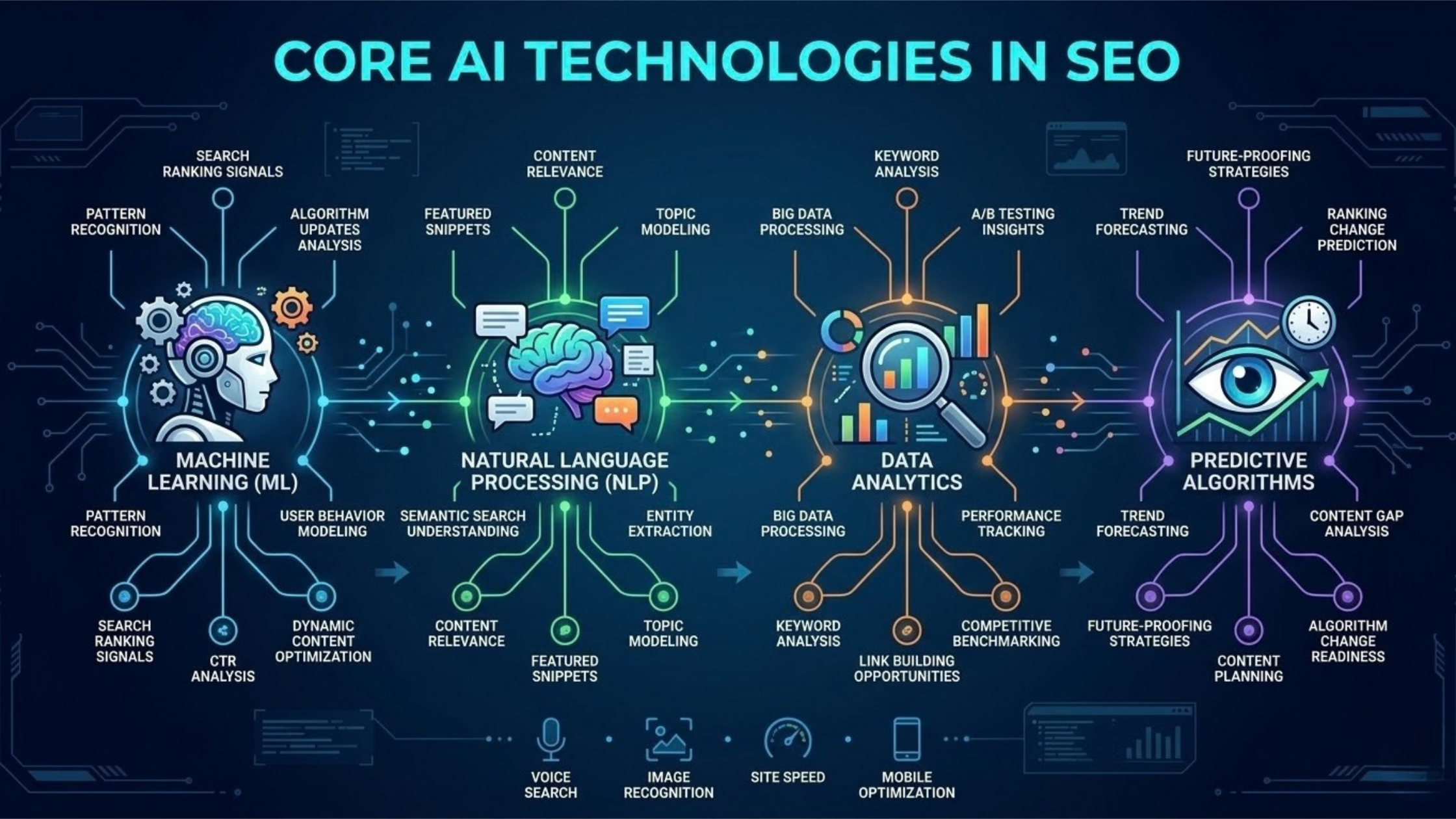
These types of questions are more likely from voice searchers. As AI algorithms get better at understanding and responding to complicated questions, voice search is becoming less of a different thing to enhance for and more of a benefit of a robust SEO method.
You can use Google's features, such as Individuals Also Ask, and your keyword research tools to identify concerns your audience will likely ask and then construct them into your content strategy. Check out these resources from SEJ to discover more about questions and answers: Advanced natural language processing means search algorithms can easily translate inquiries, even in intricate language, and return outcomes that match them.
Building Modern AI Content Strategies for Better ROI
For all these users, you need to make your site easy to navigate and concentrate on getting the top spots in highlighted snippets and local SEO outcomes. While voice search wasn't as disruptive as anticipated, it was an action in the development of natural language processing towards AI innovation. Understanding these concepts can help you be successful in modern-day SEO.
Optimizing your website for voice search provides a huge opportunity. You increase your chances of reaching prospective clients who use their voice assistants to find information. This short article uses a deep dive into voice search optimization, consisting of 6 actionable pointers to help improve your voice search rankings. Let's begin with the fundamentals.
The primary objective is to get selected by and/or check out aloud by voice assistants when users perform a voice search. Those digital assistants include Google Assistant, Apple's Siri, Microsoft's Cortana, and Amazon's Alexa. Users can likewise perform voice searches on search engines like Google utilizing desktop devices. Those results are still displayed the very same way as they are for text-based searches.
Preparing for the Rise of Conversational Queries
Since there's a minor distinction in how we expression our questions. For example, if you're looking for an Italian restaurant in your neighborhood, you're likely to type "italian restaurants near me" into a search engine. You're more likely to phrase a voice search query like this: "Hey, Siri, can you discover an Italian restaurant close by?"We talk with our voice assistants as if we're talking with genuine people.
These are the types of queries that you need to enhance for to get picked by voice assistants. Enhancing for voice search helps you reach more individuals than optimizing for text-based searches alone.Research from Statista programs that the variety of individuals utilizing digital voice assistants is anticipated to continue growing. Individuals likewise use digital assistants to.
find information. To increase the possibilities of standing for voice search inquiries, you need to implement methods that'll likewise benefit your overall SEO. Like prioritizing how fast your website loads, targeting voice search keywords in your material, and making certain your site works well on mobile gadgets. To assist you achieve company goals. More specifically,
Analyzing the ROI of Future Search Changes
voice search optimization can help:: Having your material shared by voice assistants increases brand name awareness, specifically at the regional level: Providing helpful and valuable information through voice search positions your service as reliable and credible: Making changes to optimize for voice search includes enhancing technical SEO elementswhich result in a better user experience. Here are some voice search optimization methods you can execute: Investigating(and targeting)keywords particularly for voice search can help enhance the possibilities of your material being served to users utilizing their voice assistants for responses. When researching keywords for voice search, it's a great idea to concentrate on:: These are highly specific questions that often have lower search volumes. An example of a conversational keyword is "how do i edit a pdf."While each of these keyword classifications is unique, they often overlap and can even embody attributes of one another. Lots of question keywords are long-tail keywords. And lots of long-tail keywords are conversational. So, how do you discover good keywords for voice search? The Keyword Magic Tool. To start, head to the tool and enter a seed keyword( a broad search term associated to your service or a particular subject). Pick a country and click". " Next, you'll see a list of associated keywords in addition to their respective search intent( the factor behind a searcher's query), regular monthly search volume, Keyword Problem(a metric out of 100 that conveys how tough it is to rank in the leading 10 standard search engine result for a given keyword ), and more. This will present a list of concern keywords you can target for voice search. Another excellent method to discover long-tail keywords is by utilizing the Keyword Problem filter(revealed in the tool as "KD %"). Long-tail keywords frequently have a low difficulty rating (however not constantly). It's a good concept to set the keyword trouble as"Easy "or"Very Easy. " Like this: You can also add good keyword choices to a keyword list. Click". " You can then create a brand-new list or add to an existing one. You can also export this list as a CSV, XLSX or CSV Semicolon file from Keyword.
Using Advanced AI to Scale Editorial ProductionStrategy Builder.: The information on keywords in Keyword Magic Tool isn't particular to voice search. It can still offer you a sign of the terms people are likely to browse for utilizing voice assistants. The terms Google recommends can provide you ideas for keywords you may want to target. The next action is to analyze search results page for these keywords. Look into what's already appearing on the online search engine results pages(SERPs)the pages with relevant results that search engines show to users after they get in a question. And pay special attention to SERP functions. SERP features are additional aspects on a SERP that add something new to a search engine result beyond the basic blue links. They look like this: Why do SERP functions matter? Due to the fact that a voice search study carried out in 2019 found that 70%of all responses returned from voice search occupied a SERP function. Here's an example of an abundant bit:: Different voice assistants count on different online search engine for info(Amazon's Alexa utilizes Bing, Apple's Siri uses Google, etc). It's handy to evaluate SERPs from numerous search engines for your queries. Examining SERP functions
can help you develop content that lines up with search engines'choices. You can use our SERP analysis function in Keyword Summary to study SERP functions for different keywords throughout different geographic locations. For instance, let's see what the SERP looks like for the keyword"how to edit a pdf"in London. Open the tool, go into the keyword, pick the place, and click".

"Then, scroll down to the SERP analysis section . It recognizes your most impactful content pieces and provides recommendations. To get going, head to the tool and click"" to set up your project. You'll then need to add a tracking code to your website. Once ImpactHero starts gathering information for your website(it takes about a day), you can start examining your existing material.

Latest Posts
Top Development Stacks to Consider During 2026
Improving Visibility for Mobile Queries
How Next-Gen SAAS Boosts Enterprise Growth